
Horn of Africa Initiative at a Glance

On 18 October 2019, during the World Bank Group/IMF Annual Meetings in Washington, D.C., the Ministers of Finance and other representatives of five Horn of Africa (HoA) countries - Djibouti, Eritrea, Ethiopia, Kenya, Somalia - came together in the Horn of Africa Initiative (HoA Initiative) and highlighted their commitment to follow a coordinated approach to explore regional synergies and address regional challenges. Subsequently, South Sudan and Sudan have also joined the regional integration platform. The Intergovernmental Authority for Development (IGAD) has been an integral stakeholder of the HoA Initiative since inception, and enjoys the status of a permanent observer. The African Development Bank, European Union and the World Bank have supported the Initiative since inception. Germany, the United Kingdom and the Arab Bank for Economic Development in Africa (BADEA) have joined the Initiative subsequently.
Challenges such as natural disasters, pandemics, insecurity, and fragility are trans-boundary by nature in their causes, effects and solutions. On the other hand, better regional connectivity, improved energy access and green transition, reliable and affordable digital services, trade facilitation and economic integration aimed at leveraging private sector engagement, broad-spectrum resilience ranging from food security, water security to climate adaptation and mitigation, and human capital development can significantly accelerate economic growth and poverty reduction. Regional approaches championed through the HoA Initiative can also leverage economies of scale in supporting regional public goods and combating regional public 'bads'.
To this end, the HoA Initiative is committed to pursue a dynamic prioritization of regional programs in (i) infrastructure connectivity (ii) economic integration (iii) building resilience and (iv) human capital, to complement their national programs and priorities to achieve deeper regional integration in the Horn of Africa.
The HoA Initiative presents a comprehensive business model for regional integration, encompassing policy dialogue, investments, and political ownership. Its priorities are fully aligned with the World Bank’s Africa Regional Integration and Cooperation Assistance Strategy and the strategic priorities of other donors supporting the Initiative. The HoA Initiative is a self-governing coalition of willing stakeholders in the regional development of the Horn of Africa. It is chaired on a biennial rotation by the Finance Ministers of the member countries. The Finance Ministers of Djibouti, Kenya, and Ethiopia have chaired the Initiative in the past. The Finance Minister of Somalia is the current chair of the Initiative. It is supported by a small secretariat and served by a multi-donor trust fund, supported by the European Union and Germany.
Member States
The Horn of Africa Initiative follows a country-led approach in ensuring the realization of its mandate. Today, its membership includes 7 countries that share and believe in a regional approach to economic growth and sustainable development.
The member countries are interconnected by history and culture, and share geographical linkages in the Horn of Africa. They often faced inter-related and shared challenges which are largely trans-boundary in nature, such as food insecurity, climate shocks, water scarcity, pandemics, forced displacement and locust infestation. They are also united in exploring common opportunities in regional infrastructure, economic integration, human capital and resilience-building. The 7 Horn of Africa countries have come together voluntarily to leverage holistic approaches for regional collaboration on development planning, programming and investments in regional solutions to complement country programs and investments.
The following 7 countries are members of the Horn of Africa Initiative.

Djibouti is a small country strategically located on the northeast coast of the Horn of Africa, occupying an area of 23,200 sq km. It shares borders with Eritrea, Ethiopia, and Somalia. It has the Red Sea and the Gulf of Eden on the east.

Kenya is the third-largest economy in sub-Saharan Africa after Nigeria and South Africa. The country is considered the economic and financial hub of East Africa. It has a population of 54 million as of 2022.

Ethiopia is a landlocked country in the Horn of Africa. It shares borders with Eritrea to the north, Djibouti to the northeast, Somalia to the East, Kenya to the South, South Sudan to the West, and Sudan to the Northwest. It has a total area of 1,104,300 sq km and an estimated population of 123.4 million (2022).

Eritrea is a northeast African country on the Red Sea coast. It shares borders with Ethiopia, Sudan and Djibouti. It has a total area of 117,000 square kilometers and its capital city is Asmara situated on the edge of the Eritrean highlands in the northeastern part.

Somalia has the Gulf of Aden to the north and has the longest coastline on Africa’s mainland, with a total area of 637,657 sq km. It has a population of about 17.5 million (2022). It borders Djibouti to the northwest, Ethiopia to the west, the Gulf of Aden to the north, the Indian Ocean to the east, and Kenya to the southwest.

Sudan is a country in Northeast Africa. It is bordered by Egypt to the north, Libya to the northwest, Chad to the west, the Central African Republic to the southwest, South Sudan to the south, Ethiopia to the southeast, Eritrea to the east, and the Red Sea to the northeast. It has population of about 46.8 million (2022).

The Republic of South Sudan, is a landlocked country with a population of 10.91 million (2022). It shares borders with Ethiopia, Sudan, Central African Republic, Democratic Republic of the Congo, Uganda and Kenya. It is the newest Member of the Horn of Africa Initiative.
Ministerial Platform
The Finance Ministers of the Horn of Africa Initiative provide leadership as the highest decision making group of the Initiative. The Ministerial Meetings are co-chaired by a Finance Minister who rotates biennially, and a development partner. Decisions are taken by deliberative consensus as a good practice. The Initiative does not decide by majority or voting. The rotation of country co-chair is decided by the Finance Ministers by consensus. The decision of development partner co-chair for each ministerial meeting is decided by the development partners by consensus.
The HoA Initiative holds Ministerial Meetings at different locations every quarter to review progress in implementation of HoAI’s regional integration agenda, resource mobilization for the HoA Initiative priority package and the implementation of the decisions on analytics and investment operations. The Ministerial Meetings also discuss forward-looking, relevant thematic priorities to inform its future goal-setting and prioritization. The Ministerial Meetings also serve as the highest level of trouble-shooting, problem-solving and consensus-building on implementation challenges that are brought to the attention of the Ministers by development partners.
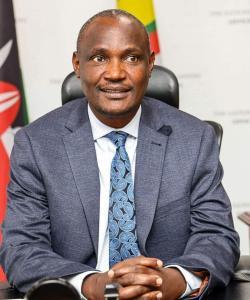
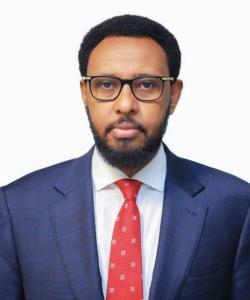
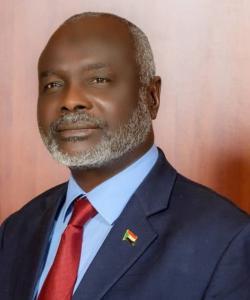
The Horn of Africa Initiative is currently chaired by the Minister of Finance of the Federal Democratic Republic of Somalia, Hon. Bihi Iman Egeh, who assumed the role at the 24th Ministerial Meeting in April 2025. He succeeds Ethiopia’s Finance Minister, H.E. Mr. Ahmed Shide, who held the chairmanship since March 2023, following Kenya’s tenure.
The Initiative is supported by five key Development Partners: the African Development Bank, the European Union, the World Bank, the German Federal Ministry for Economic Cooperation and Development (BMZ), and the UK Government via the Foreign, Commonwealth & Development Office (FCDO). Additional development partners with emerging interest may attend Ministerial Meetings as observers upon invitation.
To ensure transparency and inclusive collaboration, the Horn of Africa Initiative has adopted a Partnership Framework to guide the structured engagement of prospective development partners.

Permanent Observer
The Horn of Africa Initiative allows for inviting a relevant regional organization as permanent observer for its Ministerial and Technical Meetings. By unanimous decision of the member countries and development partners, Inter-Governmental Authority on Development (IGAD) has been a permanent observer to the Horn of Africa Initiative since its inception.

The Intergovernmental Authority on Development (IGAD) is an inter-governmental organization of eight member countries: Djibouti, Eritrea, Ethiopia, Kenya, Somalia, South Sudan, Sudan, and Uganda. It was established in 1996 to succeed the Intergovernmental Authority on Drought and Development (IGADD), founded in 1986. IGAD's mission is to promote regional cooperation and integration to add value to Member States’ efforts in achieving peace, security, and prosperity.
Areas of Cooperation
The Agreement Establishing IGAD identifies twenty areas of cooperation among the Member States. To address these areas of cooperation in a result-oriented manner, the IGAD Regional Strategy (2021–2025) has grouped them under four Pillars as follows:
Pillar 1: FOOD, NUTRITION SECURITY AND SUSTAINABLE USE OF TRANS-BOUNDARY NATURAL RESOURCES
Pillar 2: SOCIOECONOMIC DEVELOPMENT, REGIONAL INTEGRATION AND COOPERATION
Pillar 3: PEACE AND SECURITY
Pillar 4: ENABLERS
Development Partners
The Horn of Africa Initiative (HoAI) is supported by six Development Partners: the African Development Bank (AfDB), the Arab Bank for Economic Development in Africa (BADEA), the European Union (EU), the World Bank Group (WBG), the German Federal Ministry for Economic Cooperation and Development (BMZ), and the United Kingdom Foreign, Commonwealth and Development Office (UK FCDO). Other development partners expressing interest in the Initiative may attend Ministerial Meetings as observers upon invitation. The HoAI Partnership Framework guides the induction of new development partners into the Initiative.
As of September 28, 2026, six development partners (DPs) have approved 159 active projects with total commitments of USD 11.789 billion under the Horn of Africa Initiative (HoAI).
The overall portfolio includes:
As of September 28, 2026 (WBG, AfDB, EU, BMZ Germany, UK FCDO and BADEA):

The World Bank Group is an international financial institution that offers critical financial support to governments of developing countries through a range of loans and grants. These resources are used to fund vital capital projects that promote economic growth and improve the quality of life for citizens in low- and middle-income countries

The European Union is a unique and powerful political and economic entity comprising 27 member states.
The EU’s supranational structure allows for cooperation and collaboration among its member states, promoting peace, prosperity, and stability on the continent.

The African Development Bank Group or Banque Africaine de Développement is a multilateral development finance institution headquartered in Abidjan, Ivory Coast.
The AfDB is a financial provider to African governments and private companies investing in the regional member countries

The Federal Ministry for Economic Cooperation and Development is a governmental institution in Germany that focuses on promoting sustainable economic development, reducing poverty, and improving living conditions in developing countries

The Foreign, Commonwealth & Development Office (FCDO) is a department of the Government of the United Kingdom.
The Arab Bank for Economic Development in Africa (BADEA) is a multilateral development bank established by the Arab League to provide development financing and promote sustainable economic growth across African countries.
The Secretariat
The key functions of the Secretariat revolve around supporting the country chair of the Initiative, its member-states, the focal points, national advisors, and the development partners (DPs) and facilitating their interactions for smooth running of the Initiative and its workflows.
The Secretariat is also tasked with (i) convening, organizing and managing the Ministerial Meetings and other technical level meetings of the HoAI member-states on the operational priorities of the Initiative. (ii) Monitoring and reporting on status of preparation and implementation of projects to achieve the objectives of the four pillars of the HoAI initiative; and (iii) Preparation and implementation of the communications and visibility plan of the HoAI, including the upkeep and expansion of the website.